Test game: a pointer chain from the code
The gold of the test game lives on the heap: its address changes with every start and every New game. What stays the same is the way there – a pointer chain. The pointer scan finds it by searching the game's memory. This example finds the same chain another way: by reading the code that changes the gold. The game's own code knows the way, because it has to walk it every time.
It starts at add_gold, the function the code explorer example found behind the button Find treasure, and ends with the gold on the address list, found again after every New game and every restart. The second half explains, without any knowledge of assembly, how to tell a step of a chain from a plain offset – the one thing that is easy to get wrong.
Build and start the game and open View → Code explorer … as in the code explorer example.
Your addresses differ
The addresses on this page come from GCC on Fedora, which links the test game at a fixed address (image base 0x400000). Another compiler or distribution gives other numbers; the steps are the same. Take the numbers from your own code explorer.
1. The code that changes the gold
In the Functions tab, type gold into the filter and double-click add_gold. Then switch from Assembler to Pseudocode (guess):
void add_gold(int32_t a1 /* rdi */)
{
    *(int32_t *)(*(uint64_t *)(g_game + 0x28)) += a1; // 0x4006db  g_game → 0x28 → 0x0
}
One line: "add a1, the amount, to the number at …". The comment after // holds two things:
0x4006dbis the address of the instruction that does it – in the code, not where the gold is.g_game → 0x28 → 0x0is the way to the gold: the pointer chain we are after. The code explorer writes it down for every line that reaches memory from a global variable.
The disassembly says the same in three instructions:
0x4006d0  mov rax, qword ptr [rip + 0x2a31]    g_game
0x4006d7  mov rax, qword ptr [rax + 0x28]
0x4006db  add dword ptr [rax], edi
2. Reading the line from the inside out
A line like this is read from the innermost parentheses outwards, the order in which the processor does it:
| Piece | What happens | Step of the chain |
|---|---|---|
g_game |
Read the global variable g_game. It holds an address: where the Game object lies on the heap. |
Start: g_game |
g_game + 0x28 |
Go 0x28 bytes further into the Game object. Nothing is read yet. |
the offset 0x28 |
*(uint64_t *)( … ) |
Read the 8 bytes there. They are again an address: where the player's Character lies. |
→ |
*(int32_t *)( … ) |
The 4-byte number at that address, 0x0 bytes into the Character: the gold. |
→ 0x0 |
+= a1 |
Add the amount. | – |
The source of the test game confirms it (test_app/dummy_game.c): Game has a 32-byte name and a 4-byte round counter, then 4 bytes of padding and the pointer player at 0x28; Character starts with gold.
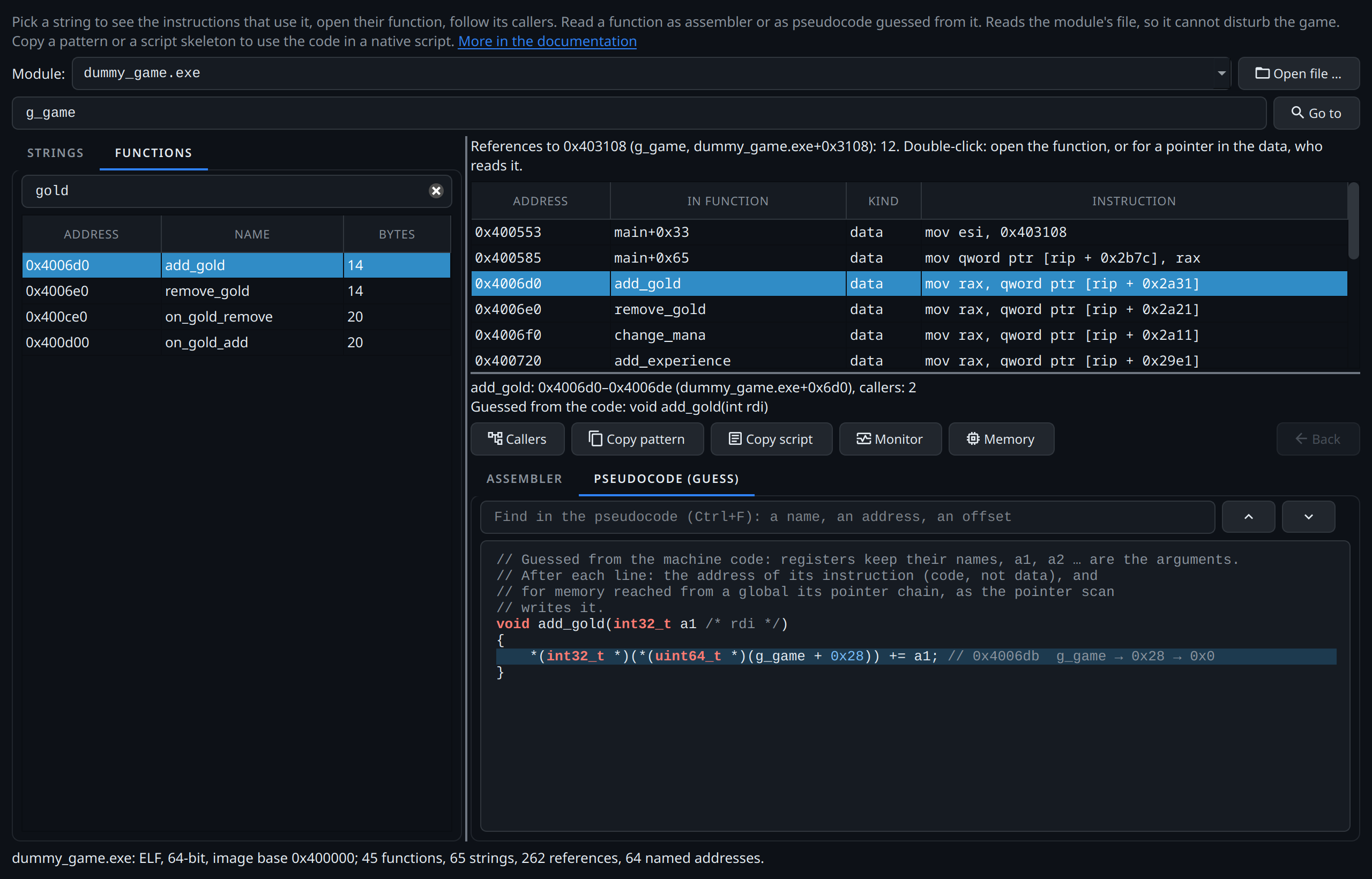
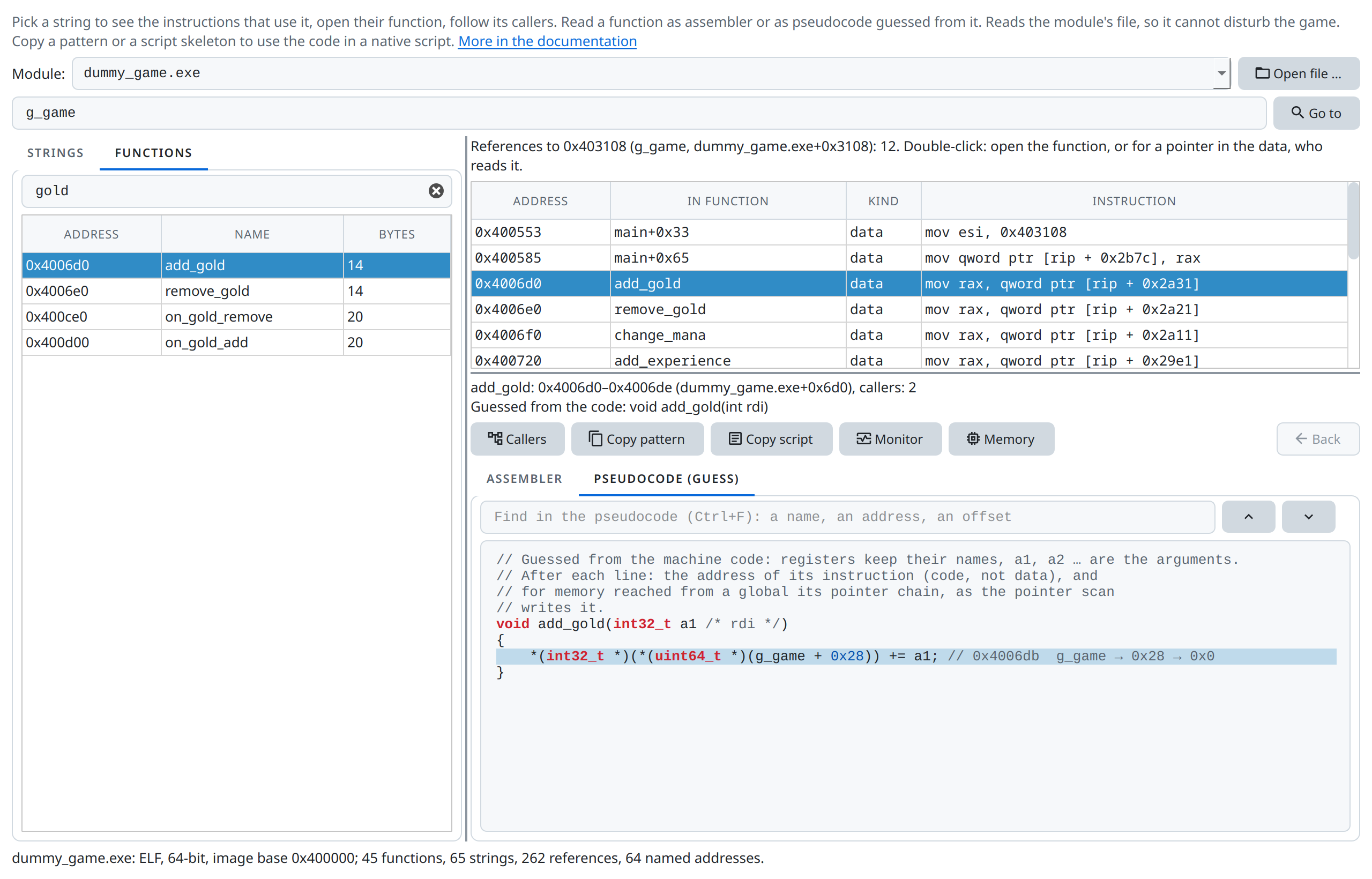
add_gold as pseudocode with its chain g_game → 0x28 → 0x0. Above it, after Go to g_game: the twelve instructions that use the global, and in the header where it lies, dummy_game.exe+0x3108.3. Where the chain starts
A chain has to start somewhere that does not move: a global variable inside the program's file. g_game is one. Type g_game into the field at the top and click Go to. The header of the references reads:
dummy_game.exe+0x3108 is the start of the chain: 0x3108 bytes into the module dummy_game.exe. Grembyte writes chains with the module, not with 0x403108, because a program built position-independent (most Linux distributions, all Windows games with ASLR) is loaded at a different address with every start – the offset inside the module stays.
So the chain of the gold is:
Every user of the gold, in one list
The references to g_game lead to every function that works with the game state: refresh_ui shows the whole player – g_game → 0x28 → 0x4 the hit points, → 0x14 the mana, → 0x18 the experience. Same way, different last offset.
4. On the address list
In the main window, below Tracked addresses, click Pointer chain … and type the chain. Arrows are typed as ->, => or :, whatever is easiest:
Choose the type int32 (the line read int32_t) and a description. Below the input the dialog says where the chain leads right now. Add.
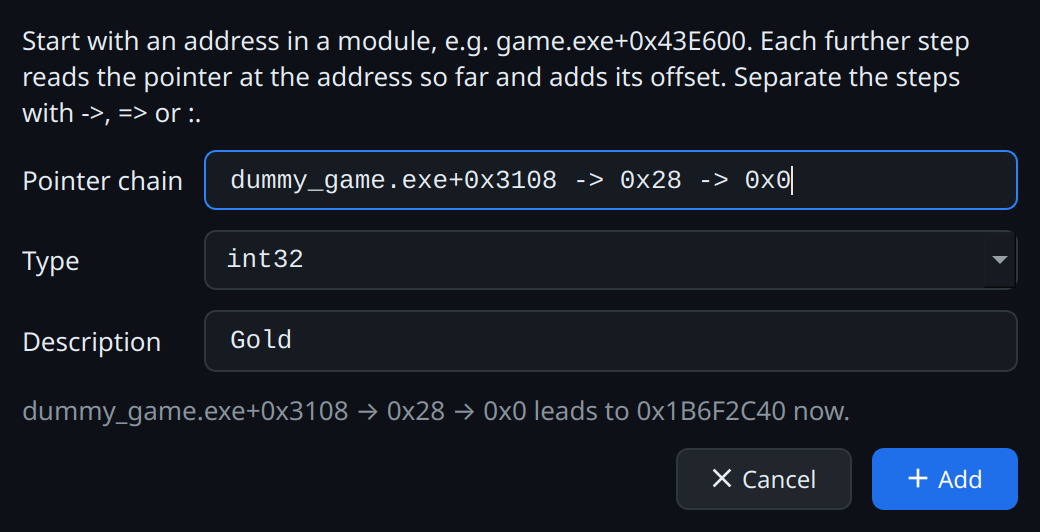
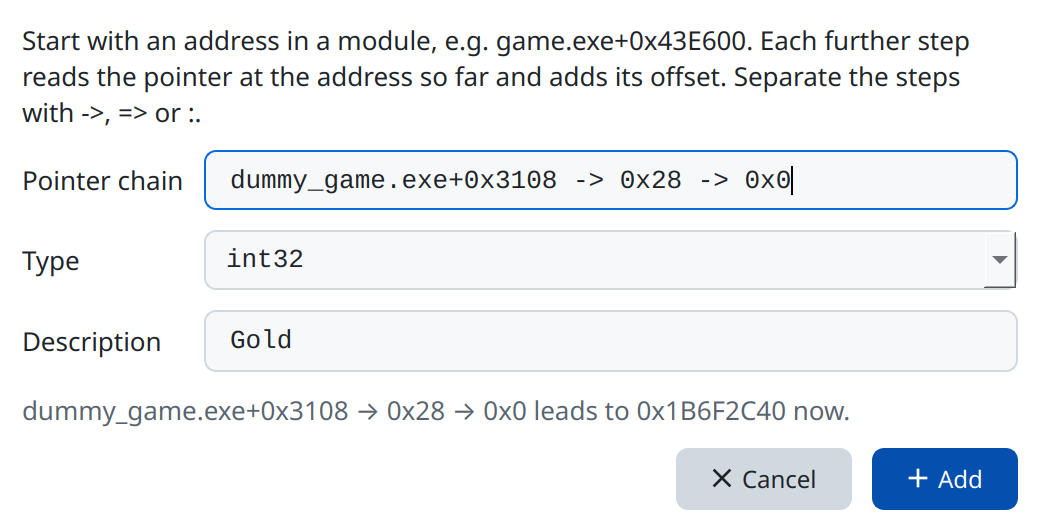
add_gold, entered by hand: it leads to the player's gold on the heap.Now check it in the game: Gold +100 changes the value on the list. New game puts the player somewhere else on the heap – the address column changes, the value is still the gold. After a restart of the game the entry finds it again, too. It is the same chain the pointer scan finds, only read from the code instead of searched in memory.
Chain or offset?
A chain has two kinds of numbers, and the whole difference is whether something is read.
The picture
Think of the game's memory as one very long street. Every byte is a house with a number.
- An offset (written
+) means: from here, walk that many houses further. Nothing is read, you only count.0x403108 + 0x28is simply house number0x403130. - An arrow (written
→) means: go into the house, read the note on the table – it holds a house number – and go there. Where you end up depends on what the note says right now. That is why a chain still works when the game moves the player: the game updates the note.
Read like that, dummy_game.exe+0x3108 → 0x28 → 0x0 says: go to house g_game and read the note (where the game is). Walk 0x28 houses further and read the note there (where the player is). Walk 0x0 houses further: here lies the gold.
dummy_game.exe+0x3108 + 0x28 would be something else entirely: the house 0x28 behind g_game – just other memory of the program, not the player.
How the code tells you
A step of the chain is a read whose result is then used as an address. In the code explorer that looks like this:
| In the disassembly | In the pseudocode | In the chain |
|---|---|---|
mov rax, qword ptr [rip + …], comment g_game – reads the global |
rax = g_game; |
the start, read with an arrow after it |
mov esi, 0x403108 or lea rax, [rip + …] – only the address, nothing read |
&g_game |
an address: offsets after it are added with + |
mov rax, qword ptr [rax + 0x28] – 8 bytes read, then used inside [ ] |
rax = *(uint64_t *)(rax + 0x28); |
→ 0x28 |
lea rbx, [rax + 0x14], add rax, 0x14 – counted, not read |
rbx = rax + 0x14;, rax += 0x14; |
+ 0x14: the same object, the last offset changes |
add dword ptr [rax], edi – the value itself, 4 bytes |
*(int32_t *)rax += a1; |
the end: the last offset, here 0x0 |
Three rules of thumb:
- Square brackets read (in the pseudocode: a
*(…)around something). The exception islea: it only computes what is in its brackets. - 8 bytes read and then used as an address (
qword,uint64_t; in a 32-bit game 4 bytes,dword) is a pointer: an arrow. A 4-byteint, afloator adoublethat is only used as a number is the value itself: the chain ends there. - Count the pointer reads. Every read of an address – the global at the start counts too – is one arrow.
*(int32_t *)(*(uint64_t *)(g_game + 0x28))readsg_gameand the player pointer: two arrows,→ 0x28 → 0x0. The last read, of the gold itself, is no arrow; it only says where the chain ends.
The test game has both kinds in one place: main prints where the gold is, with printf("g_game @ %p (pointer chain: g_game -> +%#zx player -> +%#zx gold)", &g_game, 40, 0). In the references to g_game that is mov esi, 0x403108 – the address of g_game, not its content, so the &. add_gold instead reads the content: mov rax, qword ptr [rip + 0x2a31].
When a register already holds the object
Often a function does not read the global itself but gets the object handed over – as an argument a1, in rcx under Windows (this in C++). The code of that function alone does not tell where the object lies. The native function monitor does: select the instruction, click Monitor, let the game run it, and look at the register.
- The value lies in a module – the column Meaning shows e.g.
game.exe+0x43e600: the object itself is a global. Its field is at that address plus the offset,game.exe+0x43e600+0xb0. No arrow: nothing was read to get there. - The value lies on the heap – no module in Meaning: someone read it from somewhere. Callers shows who calls the function; follow them until a line reads a global (
rax = g_game;). Each read on the way is one arrow. If that gets long, let the pointer scan do the searching.
If you mixed them up
- A
+where an arrow belongs lands in the memory right behind the global. The value on the list is some other number of the program and does not follow the game. - An arrow where a
+belongs takes a number for an address. The dialog Pointer chain … then says the chain leads nowhere right now, or the list shows nonsense.
Both are harmless – only reading is involved. Fix the entry and try again: the preview in the dialog shows at once whether the chain leads somewhere.
What carries over to real games
- Chains in real games are longer, and every function shows only its part of the way. Callers leads to where the object comes from; the pointer scan is the check from the other end.
- Stripped games have no names. Globals show up as
*(uint64_t *)0x14043e600, and the comment writes the chain with the module right away:game.exe+0x43e600 → 0x28 → 0x0. - 32-bit games have 4-byte pointers: a step of the chain reads a
dword, not aqword.