Write and read watch
The address watch answers the question which code changes this value? It sets a hardware watchpoint on the address: the processor stops the game for a moment after every write (or every access), and Grembyte records the instruction responsible.
Starting a watch
Right-click a tracked address or a scan result:
- Address watch (writes) reports every instruction that writes the address.
- Address watch (all accesses) also reports instructions that read it. x86 watchpoints trap on writes or on any access, there is no read-only mode; Grembyte decodes each instruction to tell whether it reads, writes or both.
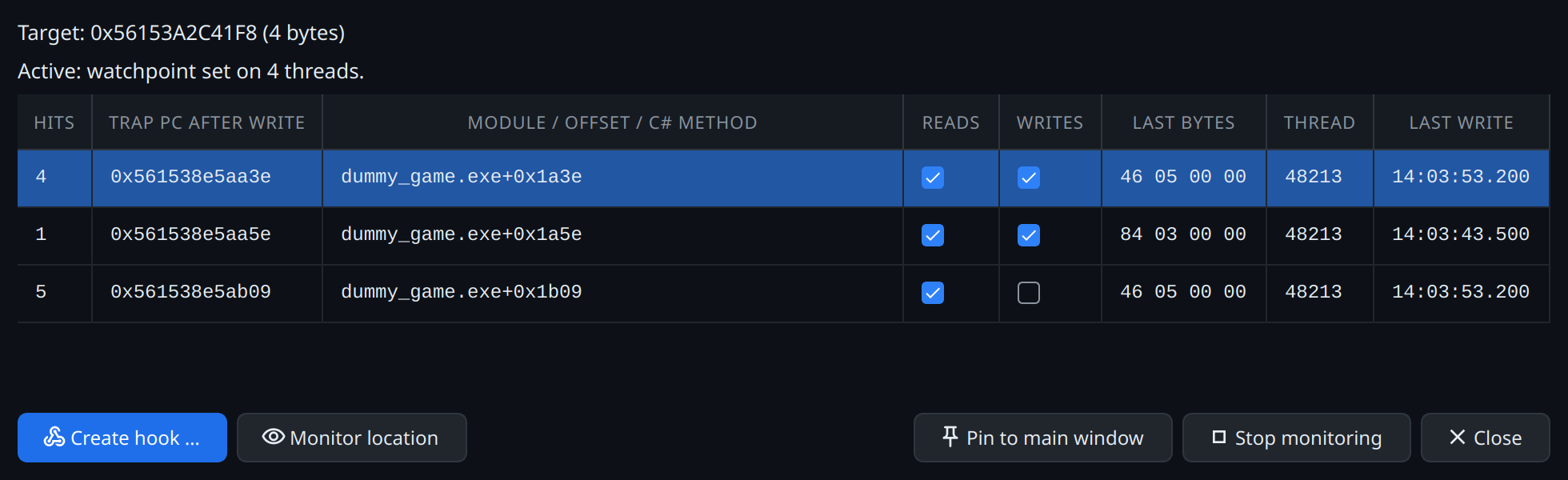
Then do in the game what changes the value. Each code location gets one row, with how often it hit and the bytes it left at the address. The columns Reads and Writes show what the row's instruction does with the value. In Mono games a hit in JIT code also names its C# method; in IL2CPP games code in GameAssembly is named as the C# method it belongs to.
Select a writing row and click Create hook to hook it. Hooks can only be set on writing instructions.
The watch can be docked beside the scanner, so it stays in view while you play.
Hooks and scripts keep working while a watch is set: a game method a script calls, or a value it reads or writes itself (ptr.writeS32(…)), runs to its end, and the watch lists the access like any other.
Backends: Frida or ptrace
The watch (and hooks) run through Frida by default. Settings → Backend (watch & hooks) switches to ptrace, which needs no injection into the game:
| Frida | ptrace (Linux only) | |
|---|---|---|
| Injection into the game | yes | no |
| Addresses at once | several | at most 4 (debug registers) |
| Hook training and caller learning | yes | no |
| 32-bit Wine/Proton games | – | chosen automatically |
The status bar shows the backend in use.
With ptrace, a watchpoint can cover 1, 2, 4 or 8 bytes only when its address is aligned to that size. Grembyte rejects an unaligned address instead of setting the watchpoint.
Anti-tamper and debug registers
Some anti-tamper protections detect the debug registers that watchpoints use; Dark Souls III crashed. Grembyte points it out when a game ends shortly after debug registers were used.