Scanning for values
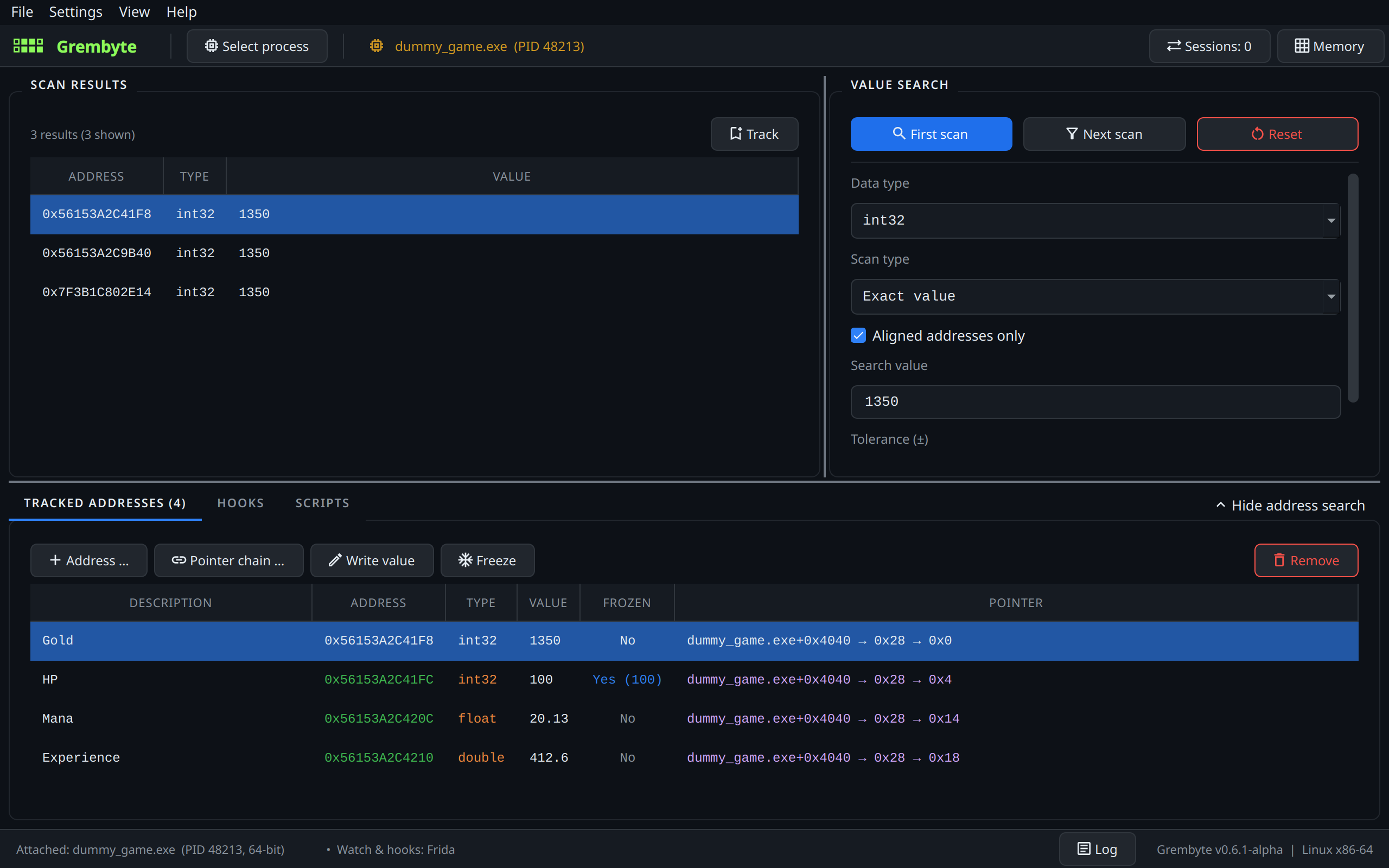
The value search on the right of the main window finds the addresses where the game keeps a value. You narrow them down in steps: a First scan over the whole memory, then Next scans over the remaining results after the value changed in the game.
Data types
| Type | Size | Use |
|---|---|---|
int8, uint8 |
1 byte | Flags, small counters |
int16, uint16 |
2 bytes | Older games, packed structures |
int32, uint32 |
4 bytes | The usual integer: gold, ammunition, levels |
int64, uint64 |
8 bytes | Large counters, money in some games |
float |
4 bytes | Health, mana, positions, multipliers |
double |
8 bytes | Experience, timers, values in managed games |
Guess automatically tries int32, int64, float and double at once. The smaller types match almost everywhere and have to be chosen explicitly.
Aligned addresses only skips addresses that are not a multiple of the type's size. Games almost always align their values, so the scan is faster and has fewer chance hits.
Scan types
First scan:
| Scan type | Finds |
|---|---|
| Exact value | Addresses holding the value |
| Greater than / less than | Values above or below the number |
| Range | Values between two numbers |
| Unknown initial value | Every address; useful when the game shows no number, e.g. a health bar |
Next scan, compared with the previous scan:
| Scan type | Keeps addresses whose value |
|---|---|
| Changed / unchanged | changed or stayed the same |
| Increased / decreased | went up or down |
| Increased by … / decreased by … / changed by … | changed by the given amount |
| Exact value, greater, less, range | as in the first scan, against the current value |
Unknown values
For a health bar without a number: Unknown initial value, take damage, Decreased, wait, Unchanged, heal, Increased – a few rounds leave few addresses.
Fuzzy scans
Games rarely show a value exactly as they store it. Two options help:
- Tolerance (±) for exact and by-X scans:
Increased by … 25with tolerance5finds increases from 20 to 30. - Float comparison for
floatanddouble: Exact, Rounded or Truncated to the decimal places you typed.12.3rounded finds 12.25 to 12.35.
The test game has examples of both:
- Mana (
float, shown with one decimal place) regenerates by 0.13 every second; a spell costs 7.5. Scan Exact value with the value shown (e.g.20.1) and Rounded; with Exact the address is hard to find, because the stored value is e.g. 20.13. Then Cast spell and scan Decreased by …7.5with tolerance0.5– the regeneration between the scans would make a comparison without tolerance fail. - Experience (
double, shown without decimals): Exact value with the number shown and Rounded; after Fight scan Increased by …12with tolerance3. - Gold (
int32): after Find treasure scan Increased by …25with tolerance5.
Taking results
Results show the address, type and live value. Select one or several and click Track (or double-click) to move them to the tracked addresses. A right-click offers the memory viewer and the write and read watch for a result directly.
The scan area folds away with Hide address search next to the tabs, View → Address search or Ctrl+Shift+F; Grembyte remembers the choice.